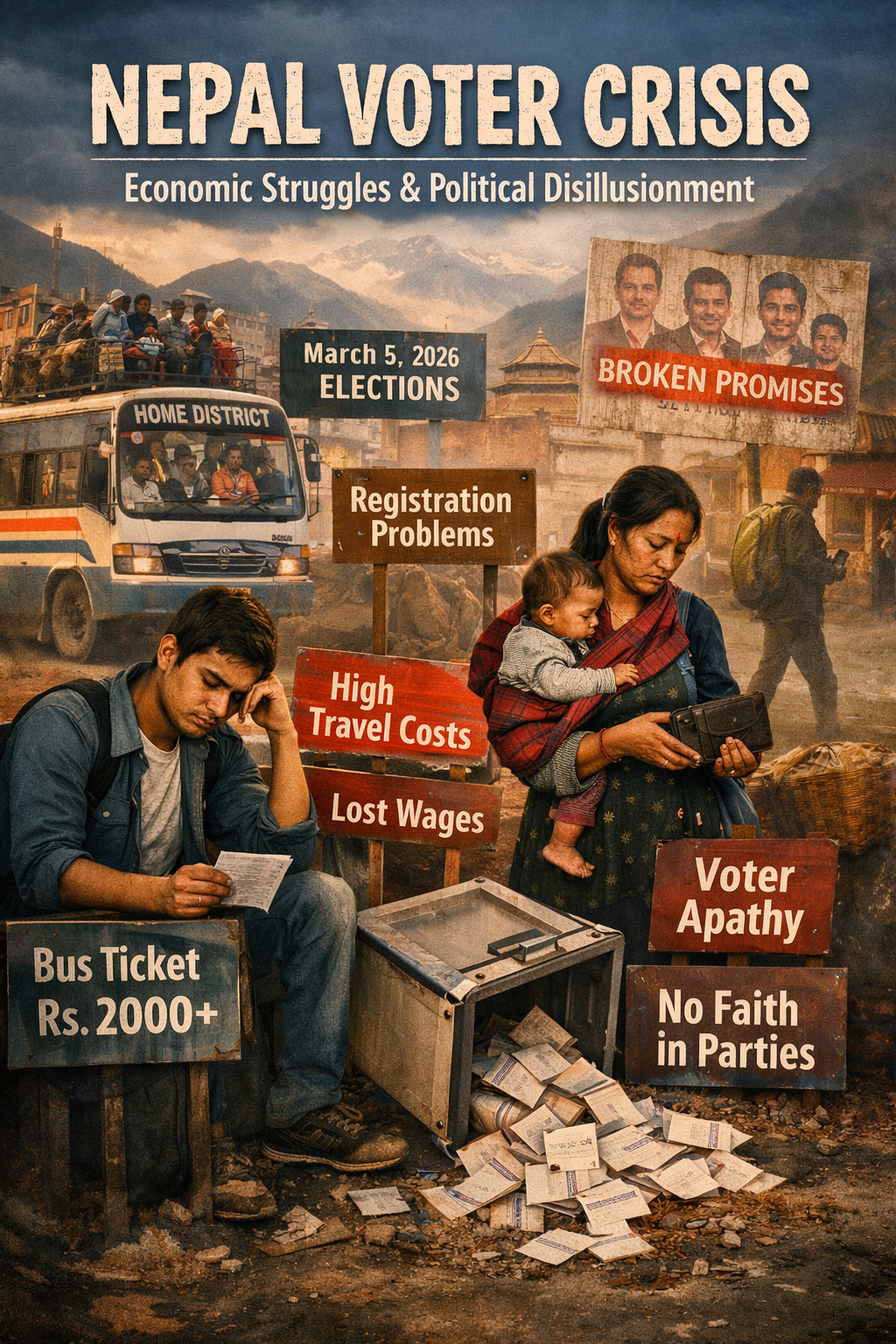
As Nepal approaches the March 5, 2026 House of Representatives election, a growing number of voters are now openly discussing their plans not to participate, not out of apathy alone, but because of deep economic pressures, systemic mistrust in political parties and a pervasive sense that governance has failed ordinary citizens. These forces are converging in ways that could significantly reduce voter turnout, especially among young, working-age adults living outside their home districts.
At the core of this unsettling dynamic is a set of practical obstacles rooted in daily life, most notably, the burden of travel costs and logistical hurdles that make voting a financially risky decision rather than a civic duty.
Travel Costs: A Practical Barrier to Participation
For many Nepalis living in urban centers such as Kathmandu, the idea of returning to their home districts just to cast a ballot has become an unaffordable luxury.
Nepal’s electoral system requires citizens to vote in the constituencies where they are registered. For hundreds of thousands of people who have migrated from rural districts to cities such as Kathmandu, Pokhara, Biratnagar, and Nepalgunj for work, this means returning to their home districts in order to cast a ballot. For many households already struggling with inflation, rent, food prices, and school fees, the expense of transport alone can be prohibitive.
Across Kathmandu and other city hubs, tens of thousands of registered voters travel back to their home constituencies as election day nears, and many find that costs, bus tickets, food, accommodation, and the loss of income during travel accumulate into an amount that outweighs any perceived benefit of casting a vote. Public transport networks are crowded toward home districts, but for families with limited savings, these journeys represent real sacrificial spending.
Addressing this challenge requires structural reforms rather than temporary campaign appeals. The expansion of mechanisms that allow citizens to vote closer to their place of residence could significantly reduce travel burdens. Improving voter registration systems to reflect internal migration patterns would align electoral administration with contemporary realities. Simplifying procedures and enhancing public awareness about registration updates could also mitigate confusion and last-minute obstacles.
Logistical and Registration Challenges Compound Costs
In addition to direct expenses, other practical barriers amplify the financial burden of voting. Poor road conditions, seasonal safety concerns, and uneven transportation infrastructure make many long journeys uncomfortable or unsafe. Meanwhile, hundreds of thousands of Nepalis working away from their registered hometowns are not listed in local voter rolls and cannot easily cast a ballot in the places where they currently reside.
For those whose names are not on any voter list, the choice becomes stark: pay more travel costs to restore their voting rights for this election or stay where they are and forgo participation altogether.
These registration gaps are particularly acute among younger urban migrants who have not updated their electoral registration after moving to cities for work. Many overwhelmingly say they have never voted, despite being eligible.
Political Parties and the Trust Deficit
Economic obstacles play a central role in voter decision-making, but they are not the only factor. A growing sentiment among many prospective voters is that even if they bothered to travel home and cast ballots, it wouldn’t matter. This mood is tied directly to several years of unmet expectations from political leaders and parties, which many see as out of touch with the everyday concerns of ordinary people.
Over successive election cycles, many citizens have watched shifting alliances, internal party splits, coalition instability, and frequent changes in government leadership. These developments have fostered a perception that political competition is driven more by power struggles among elites than by policy commitments aimed at improving ordinary lives.
Public frustration often centers on unmet promises. Campaign manifestos routinely pledge economic growth, job creation, infrastructure development, and improved public services. Yet for many households, daily realities remain stubbornly unchanged. Youth unemployment persists, inflation erodes purchasing power, and essential services such as healthcare and education continue to strain family budgets. When elections do not translate into tangible improvements, the perceived value of voting diminishes.
Why People Don’t Have Faith
A related concern is the belief that political parties have become disconnected from grassroots needs. Citizens frequently observe leaders focusing on coalition arithmetic and leadership disputes while bread-and-butter issues receive limited sustained attention. In such an environment, the act of voting can begin to feel symbolic rather than consequential. If outcomes appear predetermined by elite negotiations, the incentive for individual participation weakens. There are several interlocking reasons why so many voters now see political parties as untrustworthy or ineffective:
1. Disconnect Between Party Agendas and Daily Reality
Many citizens feel that political manifestos focus on abstract goals such as coalition politics and power sharing, while ignoring inflation, the rising cost of living, and infrastructure problems that affect daily life. Consumer rights activists lament that economic hardship has not been meaningfully addressed in party platforms, despite being an issue that respondents mention repeatedly as a priority.
2. Perception of Politicians as Self-Serving Rather Than Public-Serving
A common refrain from would-be voters is that politicians are seen as part of an entrenched elite, disconnected from the struggles of working families. Past rounds of governance, coalition instability, and political infighting have reinforced a belief among some that elections serve mainly to rotate elites rather than empower ordinary citizens.
3. Fragmentation and Internal Party Disputes
Nepal’s political landscape has seen ongoing fragmentation within major parties, disputes over leadership, and shifting allegiances that make it difficult for voters to anchor their choices. These internal controversies often dominate headlines, while substantive policy debates over jobs, healthcare, or education remain subdued, further alienating voters whose priorities are practical and immediate.
The Broader Implications of Voter Abstention
The combination of economic barriers and political disillusionment poses serious implications for Nepal’s democratic health:
Lower Turnout Could Undermine Representative Legitimacy
If large segments of the population, especially economically vulnerable voters and urban migrants, choose not to vote, it raises questions about the representative legitimacy of the outcome. When people abstain because voting is effectively too costly or because they see no point, the electoral mandate risks appearing narrower and less reflective of national sentiment.
Reflection of Broader Confidence Issues in Governance
Low participation signals not just logistical frustration but a broader crisis in governance confidence, a situation in which citizens see elections as decoupled from improved governance or better public services. That detachment is more profound than mere voter apathy; it reflects an erosion of faith in the political system’s capacity to respond to everyday needs.
Voices from Across the Country
Across regions, from densely populated hubs to remote home districts, the narrative is consistent: Nepalis are weighing the costs and benefits of participating, and right now, for many, the balance is unfavorable.
A wage worker in Kathmandu says he would love to return to his village and cast his vote but cannot justify the expense against the backdrop of stagnant income and uncertain returns. Others say they would rather use their limited resources for family needs than for travel to a polling station whose outcome might not change their economic reality.
This type of sentiment runs deeper than a single election cycle. It reflects a crisis of political engagement, one shaped by both structural constraints and evolving public expectations about accountability, policy responsiveness, and the practical value of democratic participation.
Conclusion: A Crossroads for Nepal’s Democracy
Nepal’s March 5 election is set against a backdrop of economic stress, logistical barriers, hierarchical politics, and lost trust. What happens at the ballot boxes will tell policymakers not just who the next leaders are but how engaged the citizenry remains in a system that many feel increasingly distant from.
Travel costs have become more than a practical expense they have become a symbol of the divide between everyday lives and the political arena. And without meaningful reforms that reduce barriers to participation and demonstrate tangible benefits of governance, this trend of disengagement could become a defining feature of Nepal’s democratic evolution.
Ultimately, the health of Nepal’s democracy depends not only on peaceful polling day operations or procedural compliance but on citizens’ belief that their participation matters and is accessible. The reduction of the financial cost of voting and restoring confidence in governance are not peripheral concerns; they are central to ensuring that elections remain meaningful expressions of the popular will. If these underlying issues remain unresolved, the true cost may not be measured in bus fares or lost wages alone, but in the gradual weakening of democratic legitimacy.